
Paulding County Most Wanted List
The official Paulding County Sheriff's Office uses its public web links, social channels, and app alerts to share selected wanted information. The county's reviewed materials do not publish a stable total count or a fixed update schedule for a single all-county list. The practical source is the sheriff's official alerts and quick-links page, followed by any dated wanted post it identifies.
A wanted notice can help the public recognize a person whom law enforcement is seeking. It is not the same as the Paulding County Jail roster. A person can have an unserved warrant and no custody entry, while a jailed person may never be featured as most wanted. Absence from the list therefore clears no one and says nothing about the final court result.
Photos remain on the sheriff's official channel. They should be viewed as an identification aid tied to an allegation, not as a gallery or a conviction record. Check the date, agency name, and instructions on the official post before relying on it.
The official Paulding alerts and quick-links page is the source behind the capture below. It is the place to verify a notice before sharing information.
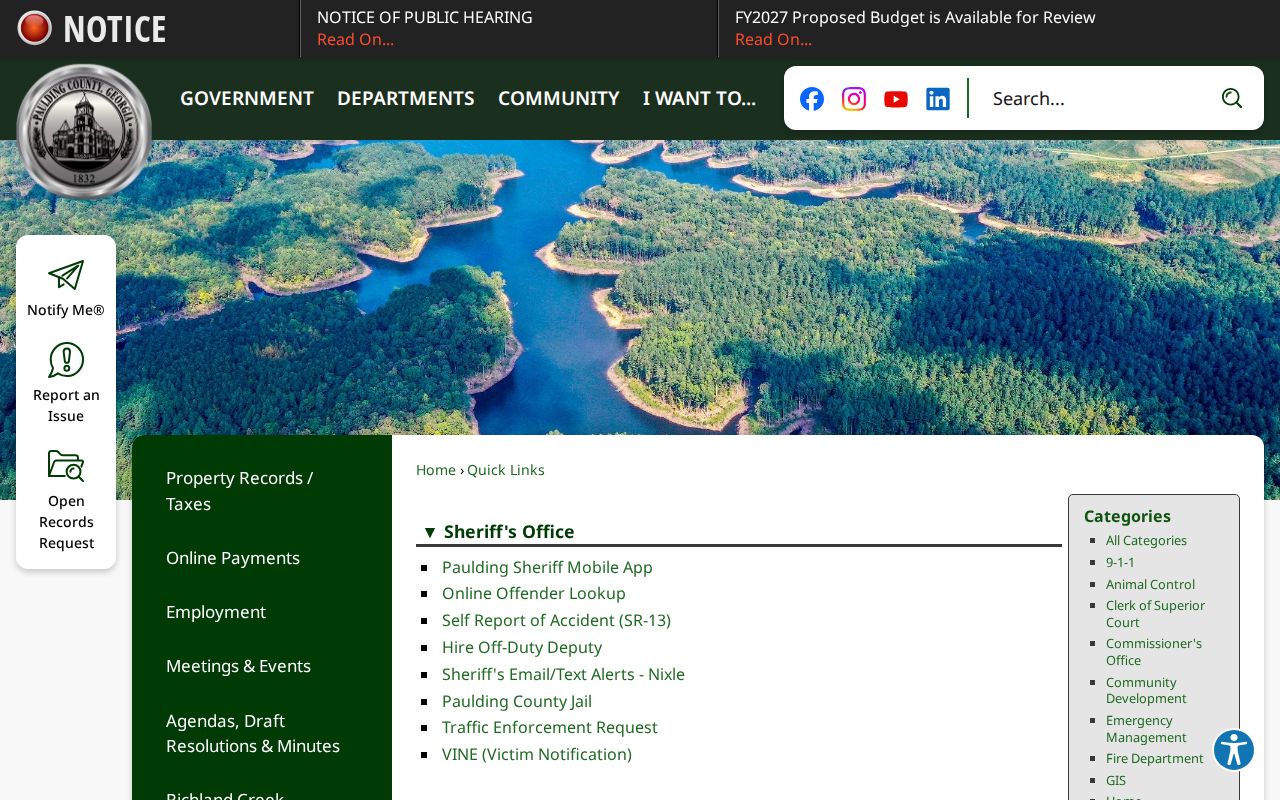
The official alerts page pictured above is the right place to confirm that a wanted notice comes from Paulding County. It does not prove that the page contains every warrant or that a listed allegation became a conviction.
Paulding Wanted Listing Details
Public wanted posts may vary by agency and date. Read the exact notice rather than assuming a field is present. The common elements below describe what a person may encounter in an official Paulding notice and how each item should be read.
| Listing element | What it means |
|---|---|
| Name | The identity label supplied by the sheriff. Check spelling and other identifiers. |
| Photo | An agency identification image when the official post includes one. It is not proof of guilt. |
| Charge or warrant basis | The reason the sheriff is asking for public assistance. It remains an charge until resolved in court. |
| Tip instructions | The official route for information, such as a sheriff channel or emergency call. |
| Date or post context | Helps determine whether the notice is current, corrected, or superseded. |
A listing normally does not show every court filing, every warrant held in a person's name, or the current custody status. When the person is later arrested, the county current-custody lookup may show a separate booking entry only while that person remains held.
How to Read the Wanted List
Use the official source as an alert, then route the next step to the correct agency. Do not copy a photo or name from an unverified repost and do not treat a social caption as a complete legal record.
- Open the sheriff's official quick-links and alert page. Confirm that the post names Paulding County Sheriff's Office.
- Read the date, charge, identifying information, and tip instructions. A selected notice is not a full warrant search.
- If you recognize someone, do not approach, follow, photograph, or attempt to detain that person.
- Use the official tip or app channel for non-emergency information. Call 911 when there is immediate danger.
- For custody information after an arrest, use the Paulding County record search and compare the name, arrest date, and charges.
Safety first: a wanted notice is not permission for public confrontation. Leave contact and detention work to law enforcement, and let a lawyer or the court address a possible warrant involving you.
Official alerts can be corrected or removed as circumstances change. A repost may remain online after the original is changed. Use the official channel and the court or sheriff for a current answer.
Paulding County Tip Channels
The reviewed county materials identify the official app as a channel for tips and online reporting. The sheriff's public quick-links also point to alerts and social sources. The research does not establish a separate public reward amount or a fixed Crime Stoppers line for every wanted notice, so no reward or anonymity promise should be added to a post that does not state one.
Official contact card: Paulding County Sheriff's Office, 180 Constitution Boulevard, Dallas, GA 30132, 770-443-3010. Use the official sheriff app page for the county's current tip and reporting options. Call 911 for an immediate threat.
Tips are for law-enforcement follow-up. They are not a way to confirm a court result, amend a booking record, or determine whether a person is guilty. Give the agency the source of the information and avoid posting identifying details or accusations to social media.
The app also links inmate lookup and Crime/Arrest Data, but it is not a complete wanted archive. Nixle and sheriff social posts can be timely while remaining episodic. Check official dates and do not read an alert channel as a comprehensive list.
The official Georgia warrant instructions provide the statewide contact path shown in the next capture. They direct a person toward the sheriff rather than an unofficial database.
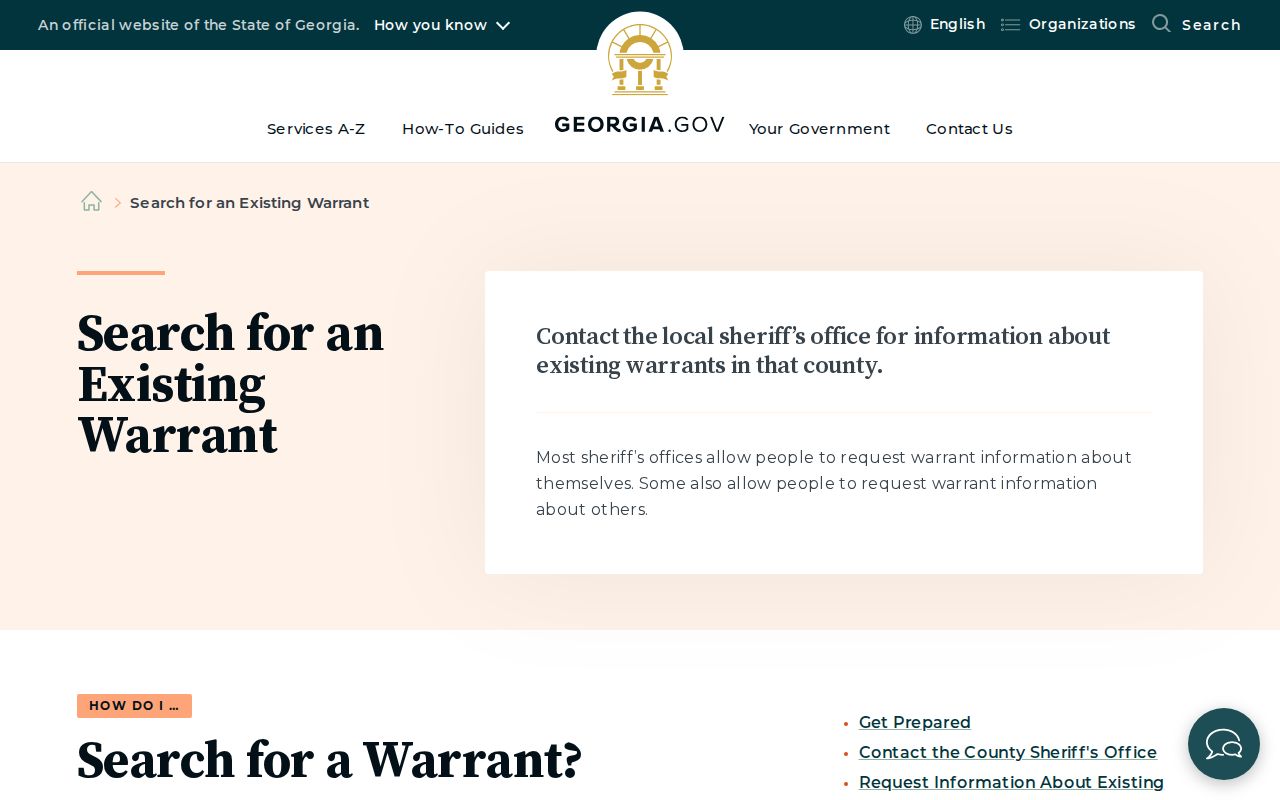
The Georgia warrant instructions shown above reinforce the local-contact route. They are not a self-service list of every Paulding warrant.
Check a Paulding County Warrant
Want to check for an active warrant? The path differs from browsing a most wanted list. Paulding has no public portal listing every outstanding warrant. Instead, Georgia.gov's official instructions direct you to the sheriff's office in the county that issued the warrant. Provide a first and last name plus date of birth. The sheriff will run the check at no cost.
Court records have limits too. A clerk docket may show a filed case or a missed court date. That is not the same as the live warrant system law enforcement uses. Ask the sheriff or the issuing court what they can confirm. Treat any unofficial database as a lead, never the final word.
- Gather the exact first name, last name, and date of birth. A name alone can produce a false match.
- Contact the Paulding County Sheriff's Office or the county named by the issuing court and ask what warrant information it releases.
- Check the appropriate Paulding court entry point for filed events, while remembering that a court docket and a sheriff warrant system have different scopes.
- If the question concerns your own status, speak with a lawyer or the issuing court about safe next steps.
- Never attempt to avoid service, hide, or confront another person. Report information through the official route.
Once a warrant turns into a booking, the county jail roster may list the person. That only lasts while they are held. After release, the entry disappears from current custody. From there, the trail moves to the sheriff's Records Division and the court docket, which is where the paper record of the case lives on.
Paulding County Warrant Types
"Warrant" is a catch-all word. The same legal event may carry one label on a court record and a different one in a jail entry. Public notices may use yet another name. When the exact type and status matter, ask the authority that issued it.
| Type or notice | Plain-language meaning |
|---|---|
| Arrest warrant | A court-authorized direction to take a person into custody based on a stated legal process. |
| Failure-to-appear matter | A court event tied to a missed required appearance. Confirm the status with the court. |
| Bench warrant | A warrant issued by a judge in response to a court-related issue. The exact effect depends on the case. |
| Most-wanted notice | A selected public-assistance post, not a separate warrant category and not a complete list. |
Keep these plain-language descriptions in perspective. They are no substitute for a lawyer's advice. A most-wanted post also cannot confirm a warrant is still active. For current status, the sheriff or the issuing court holds the answer.
Paulding Warrant Court Path
Arrest warrants in Paulding County start at the Magistrate Court. That judge also weighs probable cause. You can reach the court at 280 Constitution Boulevard, first floor, Room 1109, in Dallas. Call 770-443-7533 on a weekday between 8:00 a.m. and 5:00 p.m. The probable-cause finding simply explains why a warrant exists.
A clerk's docket can help, too. It may show a filed case, a missed court date, or a later pleading filed in the matter. Just know that a docket is not the live sheriff warrant system, so the two can disagree. When a warrant question comes with a case number, the Magistrate Court page and the Paulding Clerk of Superior Court are sensible first stops.
Court records reward patience. Read them in date order, since an indictment, a plea, a dismissal, or a sentence can rewrite what an old wanted post meant. Anyone who thinks a warrant names them should let a lawyer or the issuing court map out safe next steps instead of trusting a social media post.
Note: a court docket can support a warrant inquiry, but only the responsible sheriff or court can confirm the current status of a specific warrant.
Wanted Posts Are Not Jail Records
Two different questions, two different lists. A most wanted page answers this: whom is the sheriff asking the public to help find? A jail roster answers another: whom does the county say is in custody right now? The lists can overlap after an arrest. Neither one replaces the other.
For someone currently held, the county's official Online Offender Lookup is the right source. Search by name or book-in date. It shows the supported name, the arrest date, and the charges, and it pulls the public entry once the person is released.
For what happens later, the Paulding Clerk of Superior Court and Georgia e-access carry the case record. State prison custody is a separate world, covered by the Georgia Department of Corrections offender search. Federal and immigration custody run through BOP or ICE. None of those is a Paulding most-wanted archive or a public booking-photo source.
Accusation, Not Conviction
A wanted listing may lead to an arrest, but an arrest begins a legal process. The charge can be amended or dismissed. A photo can remain in a news archive after a person has been released, and a missing roster entry can reflect release rather than a cleared record.
Read the official court disposition before repeating an allegation as an outcome. If the sources disagree, identify which one covers current custody, which one covers the filed case, and which one is an unofficial historical or news item. The presumption of innocence applies throughout.